
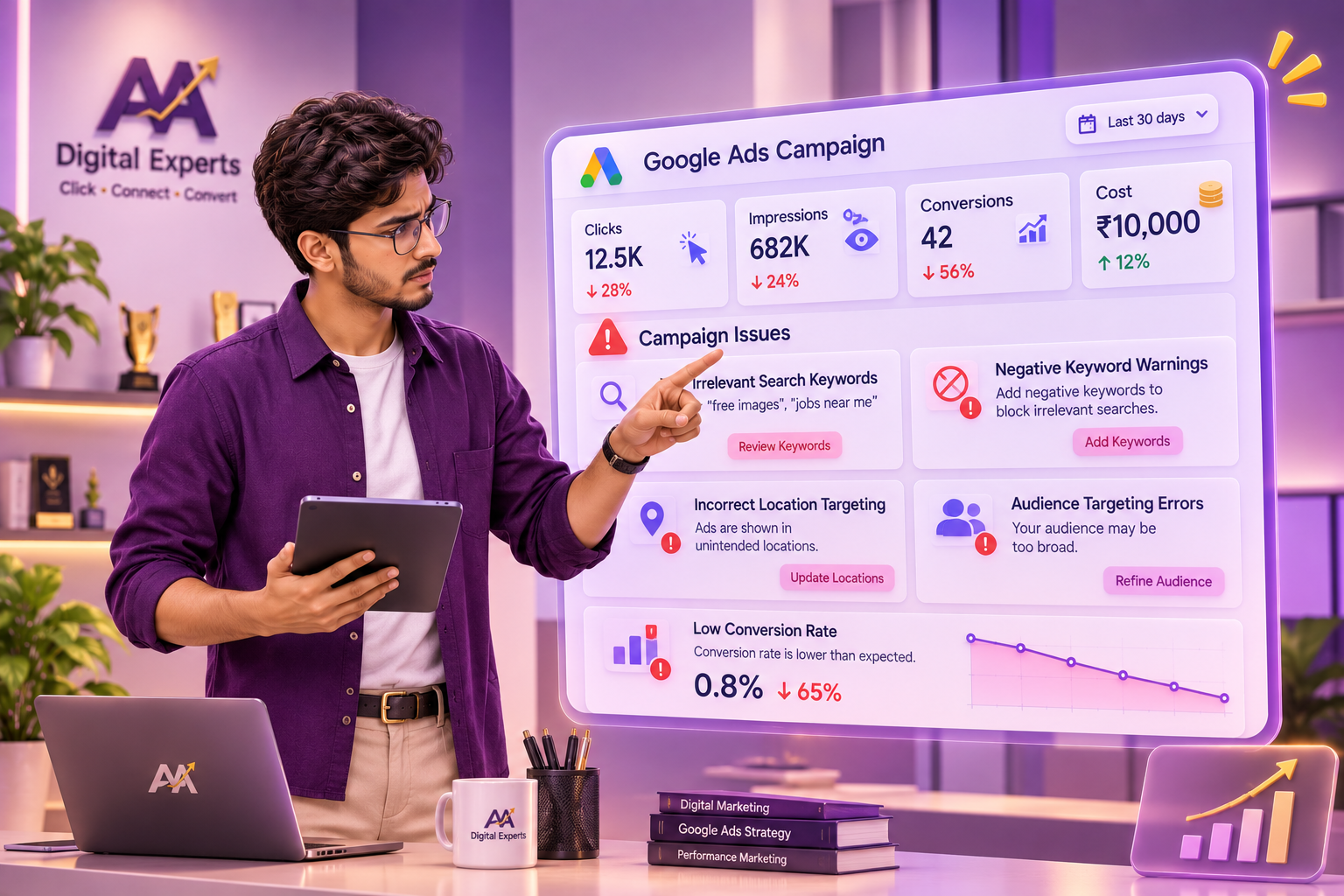
Imagine spending ₹10k on Google Ads over the course of a month, getting hundreds of clicks and absolutely no real enquiries at all. That can be a right pain.
You won’t get new customers just by running ads. A small error in your campaign setup, your keyword selection or the experience on your site can gradually chew through your ad budget.
By identifying these Google Ads mistakes, you can make better advertising decisions, get the right kind of traffic and improve your campaign performance without necessarily having to spend any more money.
Why your Google Ads budget could be going to waste
Google Ads links your business to people who are actively searching for the goods and services you provide. If your campaigns aren’t getting to the right audience or aren’t producing any real results, then you could be spending money on traffic that simply doesn’t convert.
Here are seven common mistakes to look out for.
7 Google Ads Mistakes That Are Hurting Your Business
1. Going after overly broad keywords
Using broad keywords will attract people who aren’t actually looking for what you do.
A digital marketing agency focused solely on the keyword ”marketing” might well be getting clicks from students, job seekers and people looking for marketing courses.
The fix: use keywords that are specific and relevant to your services and customer intent. Regularly review your keyword match types to improve your targeting.
2. Ignoring Negative Keywords
Not every search that causes your ad to be shown is a good one. You could end up with your ad appearing for searches that are completely irrelevant to your business if you don’t have negative keywords.
For instance, an agency that’s got a paid advertising business may get all sorts of clicks from people who are actually searching for free digital marketing courses.
The fix is to regularly check your Search Terms report and remove the irrelevant searches using negative keywords. This will go a long way toward controlling your ad spend.
3. Running Ads Without Conversion Tracking
Clicks and impressions don’t tell you how many people actually contacted your business.
You can’t properly identify which campaigns, keywords or ads are generating enquiries without conversion tracking.
For instance, a business might get 200 clicks and have absolutely no record of how many of those visitors actually filled in the enquiry form.
The fix is to set up conversion tracking for the key actions you want to track (form submissions, phone calls, purchases,s etc.). Measure the actual outcomes rather than just looking at clicks.
4. Sending Every Ad to Your Homepage
A visitor who clicks on an ad expects to find information that’s relevant to what they’ve searched for.
If a customer is looking for web design services and ends up on a generic home page rather than a specific service page, they’re likely to be confused and just go away.
The fix is to create relevant landing pages for the individual services. These should contain clear information, the benefits that the service provides and an easy way to enquire.
5. Ignoring Location and Audience Targeting
Location is important, particularly for businesses that are serving a specific city or region.
Imagine a salon in Thane running ads all over India. It could spend money on people who, in reality, would never be able to go to the salon.
The fix is to pick your locations based on your actual service area. Look at the geographic performance and then tweak your targeting accordingly based on where the relevant enquiries are coming from.
6. Using the Same Ad Copy for Every Audience
Different customers have different needs. A startup looking for cheap marketing services is going to have very different requirements from an established company looking for a full-on advertising strategy.
Using the same ads for everyone can make your message less relevant.
The fix is to write an ad copy that speaks to the actual needs of the customer. Make sure you’re talking about the right services, the right benefits and have a clear call to action.
7. Failing to Monitor and Optimize Campaign Performance
Launching a campaign and then just leaving it is another one of the common mistakes.
Keyword performance, customer behavior and ad spend all have a tendency to change over time. If you don’t regularly review your campaigns, you can end up with under-performing campaigns still eating into your budget.
The fix is to make Google Ads optimization an ongoing process. You need to be looking at the clicks, the conversions, the cost per lead, the search terms and the landing page performance. You then make your changes based on the data rather than on any assumptions you might have.
How to Make Your Google Ads Budget Work Better

You don’t necessarily need a bigger ad budget. You need a better understanding of where your current budget is going.
Start with these practical actions:
- Review your search terms regularly and get rid of the irrelevant traffic.
- Monitor your conversion tracking to pick out the real enquiries.
- Improve the relevance of the landing page and the user experience.
- Compare campaign performance rather than just going by clicks.
- Test out different ad messages and then refine your targeting.
- Small informed tweaks can go a long way to improving the efficiency with which your ad spend is being used.
Frequently Asked Questions
Why are my Google Ads spending money and not generating any leads?
Additionally, Irrelevant keywords, poor landing pages, incorrect targeting and missing conversion tracking can all be factors in poor lead generation.
How can I cut down on wasted Google Ads spend?
Ans: Review the search terms, add negative keywords, improve the targeting and then monitor the cost per conversion.
What’s a good Google Ads budget for a small business?
First, your budget depends on competition, CPC, location, and your business objectives. Start with a modest amount and then assess the results before you increase it.
Why aren’t my Google Ads clicks converting?
Moreover, visitors may find the landing page lacking the right information, messaging, or a clear way to inquire.
How do negative keywords help to reduce ad spend?
Moreover, ads stop appearing for irrelevant searches, enabling the business to target more relevant traffic.
Conclusion
However, your Google Ads budget should be supporting business growth, not just getting swallowed up by irrelevant clicks. If you can spot these Google Ads mistakes and fix them,you’ll improve your targeting, your campaign efficiency and your lead quality. Therefore, regular monitoring and sensible optimization yield real improvements over time.
Moreover, avoid wasting your budget on under-performing ads.
Therefore, your ad budget needs a strategy focused on the right audience, clicks, and business enquiries.
Therefore, at AA Digital Experts, we help businesses plan, manage, and optimize their Google Ads campaigns in line with objectives.
Additionally, are you ready to take your ad performance to the next level?
Get in touch with AA Digital Experts today.
Website: https://aadigitalexperts.com/
Contact: +91 9619663190